

Published research on how often these states are missed: 98% of stress related adjustment disorders go undetected; 71% of distress in cancer patients goes unrecognised; 86% of burned out teachers also meet criteria for depression.
I joined Vinyasa in 2024 as its product designer. People weren't filling in our forms, and the team kept chasing them. I led the fix. This is the rebuild.
A quick check in, a little room to reset, no account required. Pin it to your home screen.

About Vinyasa
Vinyasa helped people reach the right healthcare professionals, including therapists and psychiatrists.
It was working on two problems: people being misdiagnosed, and people never being directed to the right mental healthcare.
Brief: Vinyasa's users weren't filling in its forms
I was tasked with solving one problem: new users weren't finishing the onboarding questionnaire, however often the team followed up.
Project Overview
- Client
- Vinyasa, Divya Shah, Founder
- My role
- In house Product Designer and Builder
- Year
- 2024
- Duration
- 21 days
- Platform
- Progressive Web Application (PWA)
What was going wrong
Every new user had to fill in a long onboarding questionnaire before Vinyasa could help them. Almost every mental health platform works this way, BetterHelp included, so I understood why we did too.
Then I read the therapy session transcripts and talked to people in therapy on Vinyasa. The form looked fine. Its format was the problem: people in real distress often lack the mental capacity to type out long answers.
That was enough to convince the founder to try something else.
How I found this outHide how I found this out
I asked the founder for access to Vinyasa's therapists, users, session transcripts and team. Then I asked users to sit down with me, one on one.
I read the transcripts of the therapy sessions
To see what people were telling us in therapy.
I listened to the sessions, not just the words
One on one video calls with the same people, about what they were going through.
I heard what the words missed
Their voices carried feeling the transcripts never showed. The check in grew from that.
Three insights that shaped the design
Long forms ask too much of people who are already struggling
The people with the least to give were asked for the most. Every extra field was one more reason to stop.
In Vinyasa: Questions you answer with a tap, and two short spoken tasks instead of an essay.
Across 93 mental health apps, about 4 in 100 users were still active after 15 days.
Voices carry what words miss
Transcripts showed me what people said. Their voices on our video calls showed me how they felt.
In Vinyasa: I suggested we read emotion from people's voices, not only from their answers.
In studies, voice patterns help tell apart speakers with and without depression. It's a signal, not a verdict.
Trust has to be designed
People should know what a score means and where their voice goes. A calm interface isn't the same as a trustworthy one.
In Vinyasa: Plain words for every score, a clear “not a diagnosis” label, no account and nothing stored.
Vinyasa's seven areas are its own. They cover similar ground to common questionnaires but aren't one.
Problem: forms lose the people who need help most
Long forms caused people who were already mentally distressed to drop out of onboarding, so Vinyasa never got the signals it needed to direct them to the right help.
More than 75% of new users dropped off during onboarding. That left users without help, therapists unable to support them, and the business struggling to move forward.
make a mental wellness check in easy enough to finish and useful the moment it ends?
Solution: a short check in that listens
Vinyasa became a short mental wellness check in that uses audio, a person's own voice, to understand how they're doing. A few taps and two short spoken tasks replace the long questionnaire, so nobody has to type long answers.
This rebuild goes one step further, into sonic therapy. After scoring the check in, it plays calm sound, from soft keys to rain, picked to ease stress and anxiety and give some rest and relaxation (R&R).
User journey map
1Arrive
- Doing
- Opens Vinyasa in a browser.
- Risk
- Doesn't know what it will ask of them.
- Design answer
- No account or download. “How Vinyasa works” is one tap away.
2Rate and consent
- Doing
- Rates their stress from 0 to 10.
- Risk
- Worries about where their voice goes.
- Design answer
- One plain sentence: Gemini hears it, Vinyasa keeps nothing.
3Check in
- Doing
- Answers 5 short questions.
- Risk
- Typing long answers feels like too much.
- Design answer
- One tap per answer, and Next waits until they're ready.
4Speak
- Doing
- Reads a passage aloud and describes a picture.
- Risk
- Feels awkward, or the microphone is blocked.
- Design answer
- Both optional, 30 seconds at most. Skip is always there.
5Report
- Doing
- Reads 7 areas in plain words.
- Risk
- Takes a score as a diagnosis, or panics at a high one.
- Design answer
- Labelled “not a diagnosis”. Very high scores point to a doctor, therapist or helpline.
6Listen and recheck
- Doing
- Plays a calm sound, then rates their stress again.
- Risk
- Leaves with nothing to do next.
- Design answer
- One sound picked for them, and the change in their own rating.
Research: what Vinyasa was able to uncover
Vinyasa's view of mental wellness came from countless studies, research and the practical experience of its therapists. Together they showed that parts of mental wellness can be tracked and scored through sound.
Human voices carry feelings and emotions, and a trained model can pick those signals out of audio. In the original MVP I used the Thymia API to do this and score users against standard mental health criteria.
The three studies that matter most
Music and stress
104
randomised controlled trials
9,617
participants
d = 0.545
Psychological stress outcome
Music eased stress, more in how people felt than in their bodies. d = 0.545 is an effect size, not a 54.5% drop.
Music therapy and stress
47
studies
2,747
participants
d = 0.723
Outcomes related to stress
Music therapy, a structured approach, had a medium to large effect. An app playing music is not the same thing.
Why results vary
14
experimental studies
706
participants
not statistically significant
Overall effect in the short term
Lab studies found no clear overall effect of music on stress recovery, so Vinyasa never promises one.
More findings, with their sourcesHide the findings
The first three are the figures that open this page.
Stress: 98%
GPs detected only 2 of 110 cases of adjustment disorder, a diagnosis linked to stress. 3,815 primary care patients, Catalonia.
Distress: 71%
Doctors recognised only 29% of patients whose GHQ-12 scores suggested psychological distress, so about 7 in 10 went unrecognised. 2,297 patients, 34 UK cancer centres.
Exhaustion: 86%
86% of teachers classed as burned out met criteria for a provisional diagnosis of depression on a standard screening form. 1,386 US teachers.
Sleep
Music improved sleep as adults with insomnia rated it, but not clearly when sleep was measured.
Depression
With a qualified therapist, music therapy added to usual care eased depression in the short term.
Mental fatigue
In small experiments, upbeat music helped with mental fatigue more than relaxing music did.
Natural sounds
Natural sounds lowered some body measures of stress, but people didn't report feeling less stressed.
Voice
In studies, voice patterns help tell apart speakers with and without depression. It's a signal, not a verdict.
Drop off
Across 93 mental health apps, about 4 in 100 users were still active after 15 days.
Short forms
A short PHQ-9 form of three questions had 98% sensitivity and 76% specificity, not yet checked against interviews.
Seven areas
Vinyasa's seven areas are its own. They cover similar ground to common questionnaires but aren't one.
Prototype: the rebuild, two years after the original
From the 2024 MVP to this rebuild
The original MVP, built in 2024, ran on the Thymia API and a HIPAA compliant language model. It was later acquired by a US mental health startup.
Two years on, I rebuilt it from scratch and made it free to try. Every screen below is from this rebuild. It runs on free tools, so its voice readings are less accurate than the original's.
Information architecture
Vinyasa
Welcome
- First name, if they want
- How Vinyasa works
- Menu: privacy, terms, case study
Check in
- Stress rating and voice consent
- 5 questions, one tap each
- Read aloud (optional)
- Describe a picture (optional)
Results
- Report: 7 areas
- Scorecard to save
- Your next step: one sound
Listen
- 22 calm sounds, made in the browser
- Stress rating again
- Check in again, or finish
Need help now?
Helplines, one tap away on every screen.
Crisis language
If the voice step hears it, helplines come before the report.
Six Moments in the User Journey
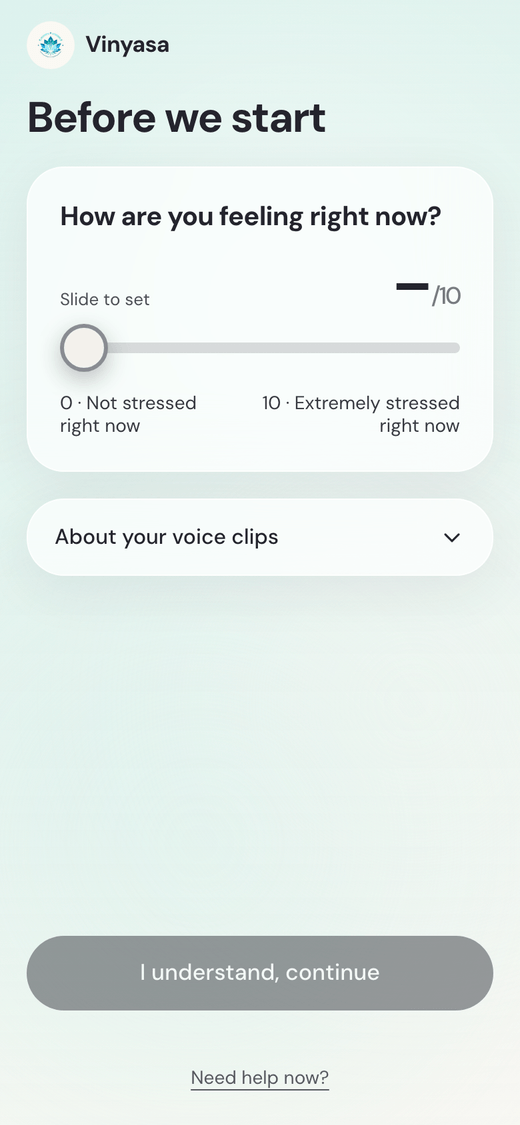
Consent and baseline
A 0 to 10 rating of how stressed you feel, and a note on your voice.
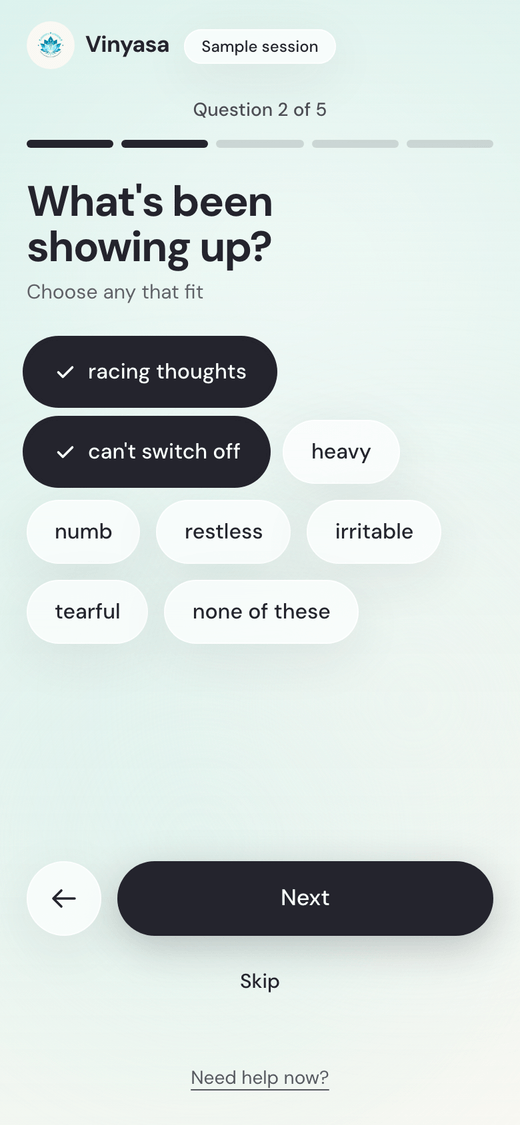
Quick check in
Tap an answer, then press Next. Skip is always there.
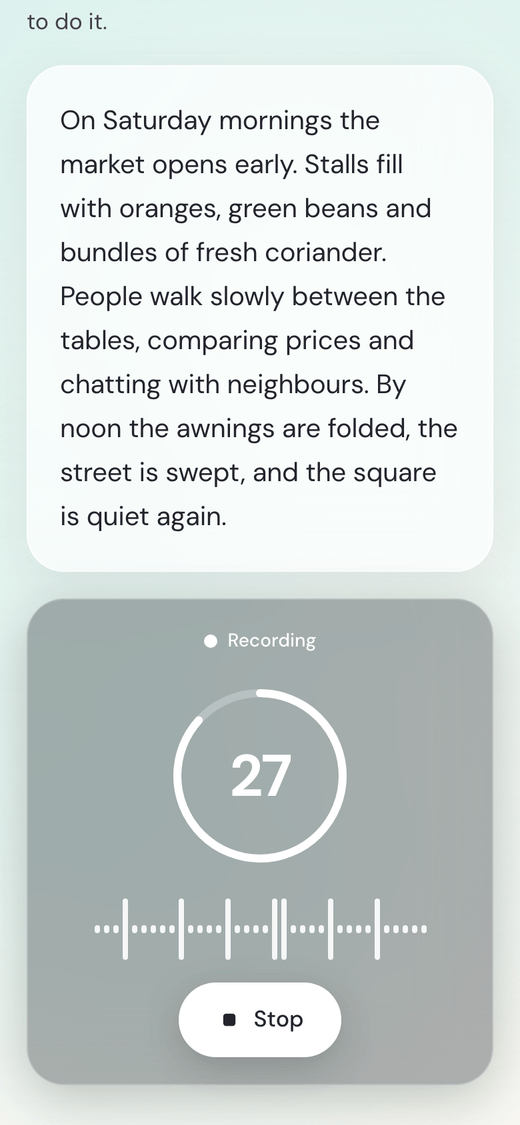
Read aloud
An optional reading of up to 30 seconds. Skip is one tap away.
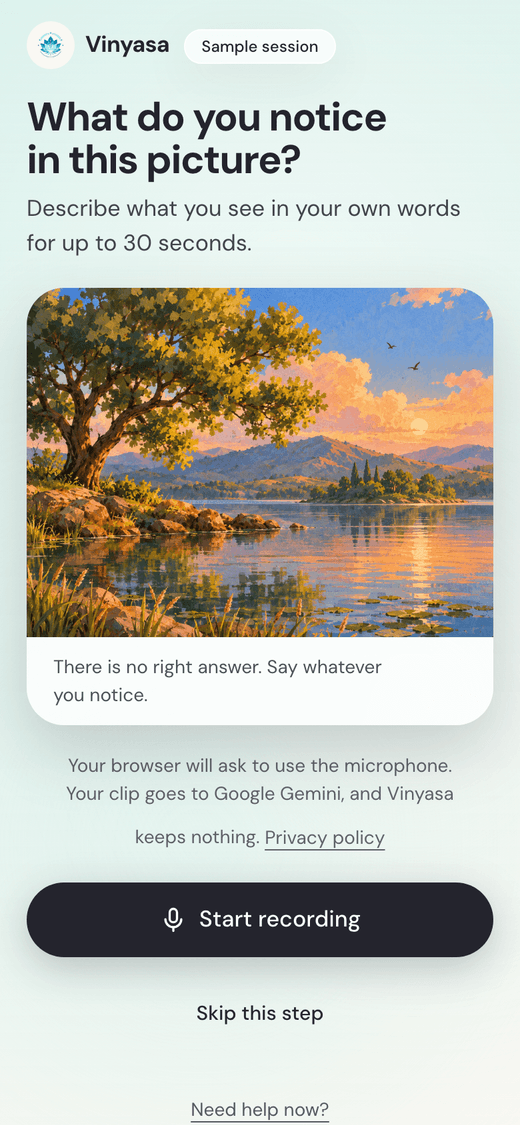
Describe a picture
Describe a calm picture in your own words. Skip anytime.
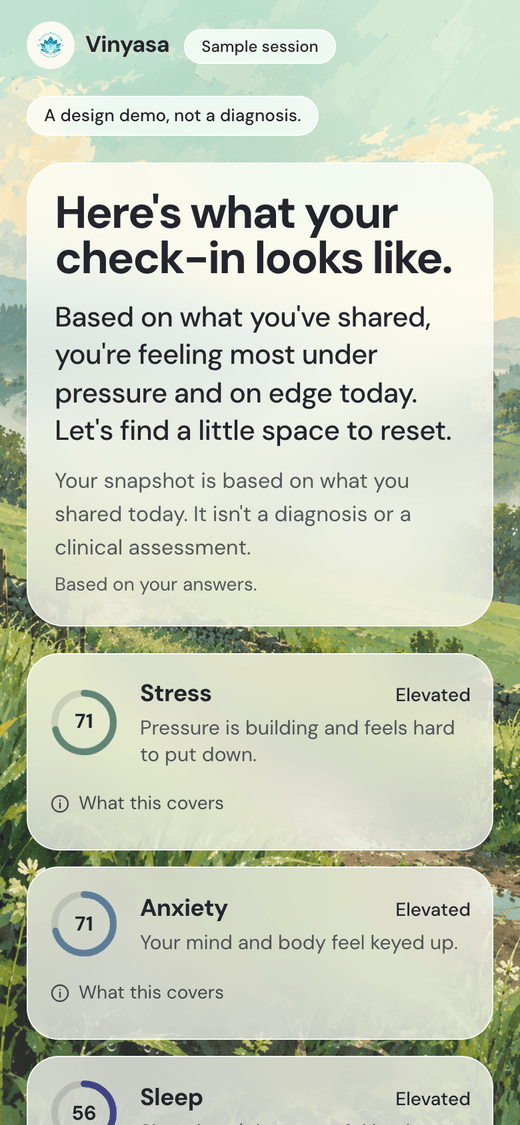
The report
Seven areas in plain words, all from your own answers.
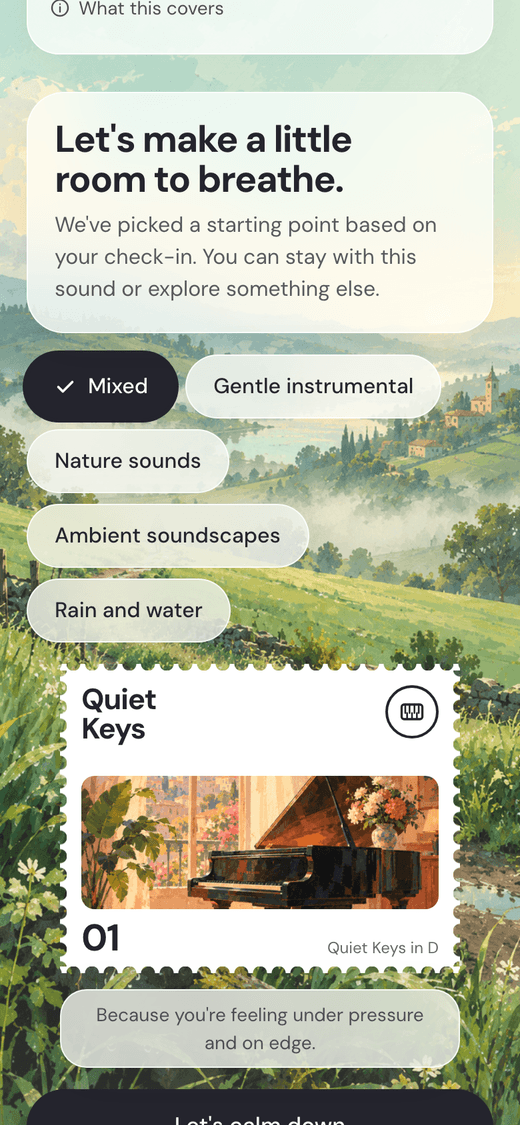
Your next step
One recommended sound, with other sounds a tap away.
Edge cases
The rebuild runs in a browser, on free tools and a tight timeline. Those limits decided what I handled and what I traded off.
Accounted for
Microphone blocked or missing
A plain message, and Skip still leads to a result.
Silent or very short clip
Caught before anything is sent. Try again, or skip.
Slow or failed voice analysis
Two AI models race. If both are slow, the report uses the answers alone.
An unexpected AI reply
Checked against a strict format. The AI's own words are never shown.
Crisis language
Helplines come first, and the report stays one tap away.
Skipped questions
Scored from what was answered, with “Not enough to say” for the rest.
Traded off
- Time
Crisis phrases
English and basic Hinglish only, not yet reviewed by a clinician.
- Budget
Voice accuracy
Gemini's free tier is less accurate than the Thymia API the 2024 MVP used.
- Budget
Free quota
When it runs out, the report falls back to the answers alone.
- Platform
Locked iPhone
iPhone may pause browser sound when the screen locks. The app says so.
- Platform
Screening needs a voice
A skipped voice step can't be screened, so “Need help now?” stays one tap away.
Outcome: what changed, and what a session leaves
The impact of the 2024 MVP
- Onboarding drop off
- Before
- 75%
- After
- 17%
of new users dropped off during onboarding.
- Check in
- Before
- A long form
- After
- About 3 minutes
of taps and two short spoken tasks, nothing to type.
- Build
- Before
- A brief
- After
- An MVP
designed and built end to end in 21 days.
- Business
- Before
- Struggling
- After
- Acquired
by a US mental health startup.
Before, during and after
Screens from one session made with sample data, not a real user.
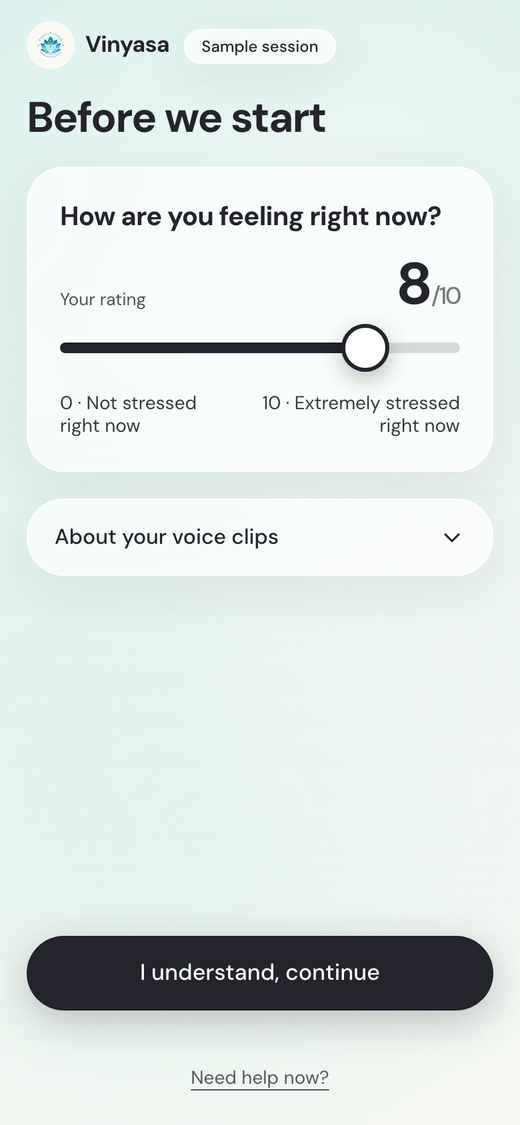
Before
A 0 to 10 stress rating before listening sets the baseline.
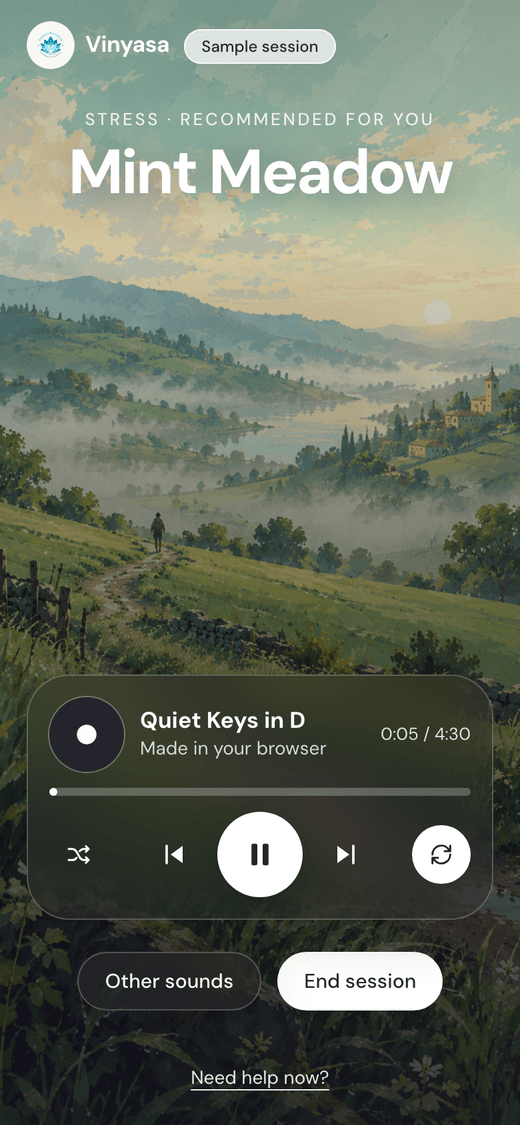
During
A calm scene and simple controls keep the sound in front.
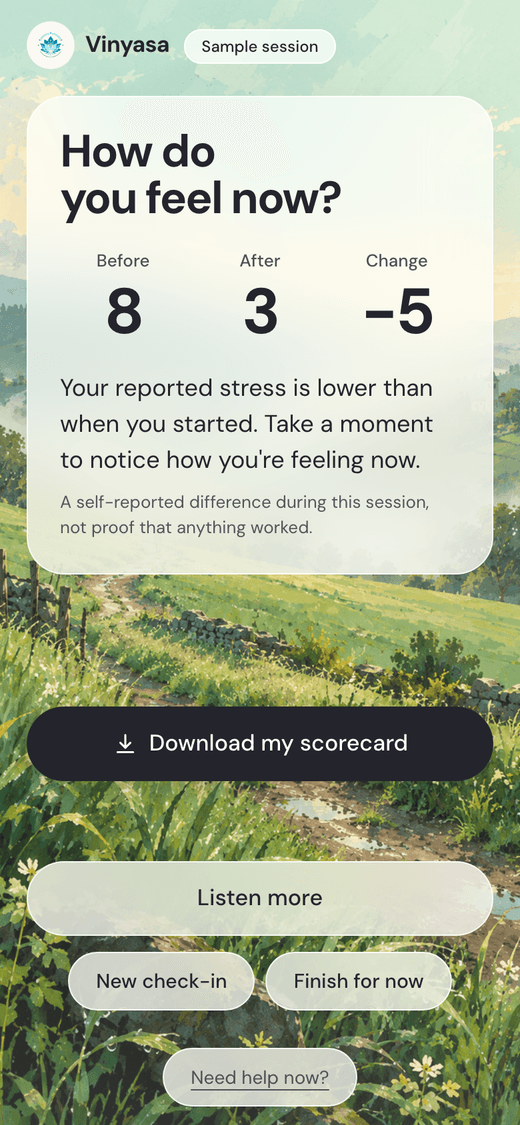
After
One more rating shows the change. Your own rating, not proof.
What I took from it
A check in only works if it asks very little. A product only works if people trust it. Both came from listening before I designed anything.
This rebuild doesn't claim to fix mental health issues or act as a treatment.
It's a free rebuild of the original MVP that lets people check in on their mental wellness, so you can try the solution yourself.